Berberis vulgaris Linn.
1. Taxonomic, Nomenclature & Therapeutic Summary Table
| Botanical Attribute | Pharmacognostic & Therapeutic Specification |
|---|---|
| Family | Berberidaceae. |
| Habitat | Distributed in Northwestern Himalayas. |
| English | Common Barberry, True Barberry. |
| Ayurvedic | Daruharidraa (var.). |
| Folk | Chatrod, Kashmal. |
| Action | Root and bark—used for ailments of gastrointestinal tract, liver, gallbladder, kidney and urinary tract, respiratory tract, also as a febrifuge and blood purifier. |
| Key Application | Listed by German Commission E among unapproved herbs. |
| Taxonomic Cohort | Genus Berberis (3 documented species); Family Berberidaceae (6 documented species). |
2. Classical Nomenclature, Taxonomy & Biogeographical Context
Berberis vulgaris (taxonomically cited with authority Linn.) is an established medicinal plant species in Indian materia medica. It is classified under the botanical family Berberidaceae (primary family classification: Berberidaceae), placing it within a well-defined chemotaxonomic group of medicinal flora. Within botanical taxonomy, this taxon is cataloged directly under its primary accepted binomial without secondary botanical synonyms. Biogeographically, its documented habitat and ecological distribution span: Distributed in Northwestern Himalayas.
Across classical and vernacular Indian systems of medicine, Berberis vulgaris is recognized under distinct polyglot nomenclature: in English botanical and trade usage as Common Barberry, True Barberry; in the Ayurvedic system (synchronized across The Ayurvedic Pharmacopoeia of India, CCRAS Standard Nomenclature, Sharangadhara Samhita, and Bhava Prakash) as Daruharidraa (var.); in regional Indian folk and vernacular ethnobotany as Chatrod, Kashmal. Romanized Sanskrit and Ayurvedic spellings follow standard National Academy of Ayurveda (Rashtriya Ayurveda Vidyapeeth) transliteration conventions, using double vowels to preserve authentic classical pronunciation across regional medical traditions.
3. Therapeutic Actions, Phytochemistry & Pharmacological Profile
In therapeutic and clinical pharmacognosy, the primary recorded actions and clinical indications of Berberis vulgaris are: Root and bark—used for ailments of gastrointestinal tract, liver, gallbladder, kidney and urinary tract, respiratory tract, also as a febrifuge and blood purifier. These traditional and clinical attributes reflect the plant part-specific pharmacological profile documented across classical Indian treatises and modern herbal pharmacopoeias. Furthermore, international and national regulatory monographs highlight its validated key clinical application: Listed by German Commission E among unapproved herbs.
Experimental phytochemistry, active chemical constituents, and pharmacological screening studies reported for Berberis vulgaris establish the following evidence base: An extract with 80% berberine and additional alkaloids stimulated the bile secretion of rats by 72%. (PDR.) As cholagogue. (The British Herbal Pharmacopoeia.) The main alkaloid is berberine (well tolerated up to 0.5 g). Berries are safe. Bererine in small doses stimulates the respiratory system; poisonings have been observed from overdoses. Poisonings from the total herb have not been reported. (German Commission E.) Berberine is bactericidal, amoebicidal and trypanocidal. Berberine is antidiarrhoeal, as it enters into the cytosol or binds to the cell membrane and inhibits the catalytic unit of andenylate cyclase. It is active in vitro and in animals against cholera. Berberine stimulates bile secretion and shows sedative, hypotensive, anticonvulsant and uterine stimulant activity in animals. Alkaloid bermarine is also strongly antibacterial. It has been shown to increase white blood cell and platelet counts in animals with iatrogenic leukocytopaenia. Berberine, berbamine and jatrorrhizine are hypotensive and sedative. Many of the alkaloids are antineoplastic. The alkaloid berbamine (50 mg three times daily for 1–4 weeks) helped reverse leukopaenia induced by benzene, cancer chemotherapy or radiotherapy in a clinical study. (Francis Brinker.) Berberine, when combined with pyrimethamine, was more effective than combinations with other antibiotics in treating chloroquine-resistant malaria. (Sharon M. Herr.)
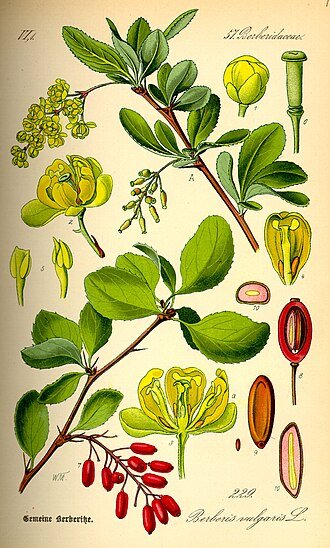
Botanical Reference 1: Berberis vulgaris — Botanical specimen
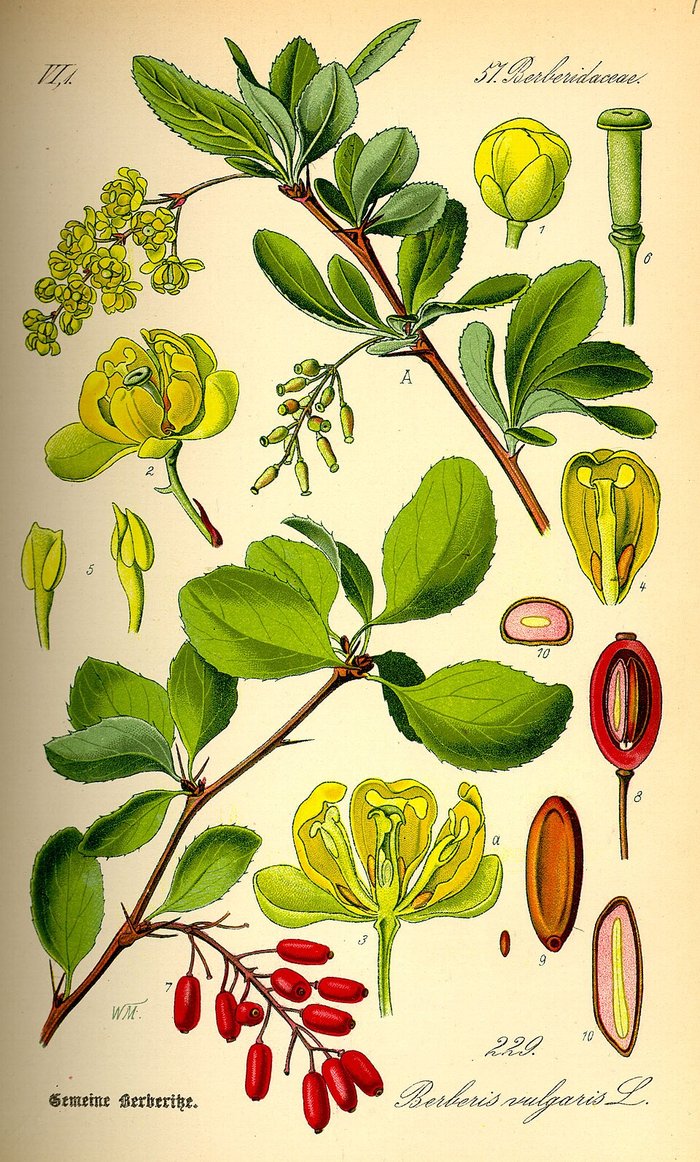
Botanical Reference 2: Berberis vulgaris — Botanical specimen
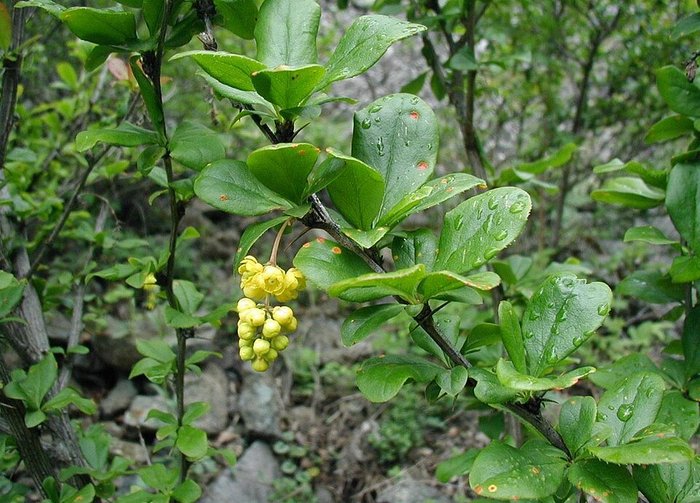
Botanical Reference 3: Berberis vulgaris — Wikimedia Commons reference
4. Comparative Genus & Family Pharmacognosy
Taxonomically, the genus Berberis comprises 3 distinct medicinal species in Indian herbal literature. Closely allied congeneric species include: Berberis aristata (Action: Rasaut, Rasasranjana (extract)—bitter, cholagogue, antidiarrhoeal, stomachic…); Berberis chitria (Action: Same as that of Berberis aristata). Comparing Berberis vulgaris alongside its congeners in genus Berberis highlights both shared secondary metabolite classes and species-specific organotropism across different ecological zones.
At the family level, Berberidaceae encompasses 6 documented medicinal species (0.33% of the 1,814-species flora). Other representative medicinal members of Berberidaceae include: Berberis aristata (Daaruharidraa), Berberis chitria (Daaruharidraa), Mahonia napalensis (Holly Leaved Berberry), Podophyllum hexandrum (Giriparpata). In comparative pharmacognosy, evaluating species within the same botanical family aids quality control, authentication of crude drugs, and identification of chemotaxonomic markers.
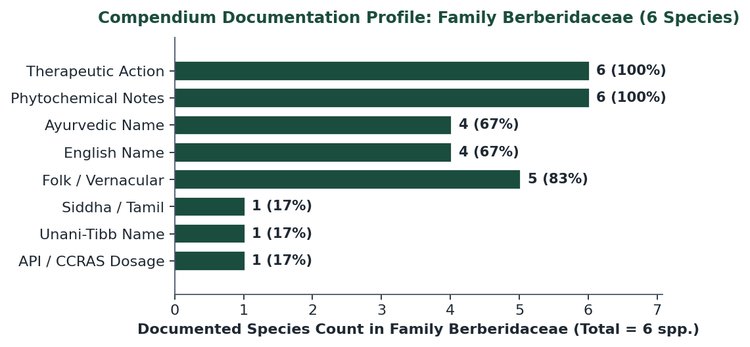
Figure 1: Quantitative documentation profile across all 6 medicinal species of family Berberidaceae.
5. Pharmacopoeial Standards, Posology & Reference Framework
In clinical and traditional dispensing, preparation and administration of Berberis vulgaris follow the plant-part modalities specified under its therapeutic action (Root and bark—used for ailments of gastrointestinal tract, liver, gallbladder, kidney and urinary tract, respiratory tract, also as a febrifuge and blood purifier), guided by the standard posological principles of The Ayurvedic Pharmacopoeia of India (Vols. I–IV) and CCRAS formularies. Classical and modern pharmacognostic synchronization for Berberis vulgaris integrates standards from The Ayurvedic Pharmacopoeia of India, The National Formulary of Unani Medicine, Formulary of Siddha Medicine, The Wealth of India (CSIR), Compendium of Indian Medicinal Plants (CDRI), Dictionary of Indian Medicinal Plants (CIMAP), German Commission E, ESCOP, WHO monographs, British Herbal Pharmacopoeia, and Natural Medicines Comprehensive Database.