Borago officinalis Linn.
1. Taxonomic, Nomenclature & Therapeutic Summary Table
| Botanical Attribute | Pharmacognostic & Therapeutic Specification |
|---|---|
| Family | Boraginaceae. |
| Habitat | The Mediteranean region, Europe and Asia. |
| English | Borage, Cow’s Tongue Plant. |
| Unani | Gaozabaan (Onosma bracteatum Wall. has also been equated with Gaozabaan). |
| Action | Fresh herb (compounded with water)—refreshing, restorative and nervine tonic. Leaves and flowers—diuretic, febrifuge, expectorant, demulcent, emollient; promote the activity of kidneys; alleviate pulmonary affections. |
| Taxonomic Cohort | Genus Borago (1 documented species); Family Boraginaceae (16 documented species). |
2. Classical Nomenclature, Taxonomy & Biogeographical Context
Borago officinalis (taxonomically cited with authority Linn.) is an established medicinal plant species in Indian materia medica. It is classified under the botanical family Boraginaceae (primary family classification: Boraginaceae), placing it within a well-defined chemotaxonomic group of medicinal flora. Within botanical taxonomy, this taxon is cataloged directly under its primary accepted binomial without secondary botanical synonyms. Biogeographically, its documented habitat and ecological distribution span: The Mediteranean region, Europe and Asia.
Across classical and vernacular Indian systems of medicine, Borago officinalis is recognized under distinct polyglot nomenclature: in English botanical and trade usage as Borage, Cow’s Tongue Plant; in the Unani-Tibb materia medica (recorded in The National Formulary of Unani Medicine and CCRUM literature) as Gaozabaan (Onosma bracteatum Wall. has also been equated with Gaozabaan). Romanized Sanskrit and Ayurvedic spellings follow standard National Academy of Ayurveda (Rashtriya Ayurveda Vidyapeeth) transliteration conventions, using double vowels to preserve authentic classical pronunciation across regional medical traditions.
3. Therapeutic Actions, Phytochemistry & Pharmacological Profile
In therapeutic and clinical pharmacognosy, the primary recorded actions and clinical indications of Borago officinalis are: Fresh herb (compounded with water)—refreshing, restorative and nervine tonic. Leaves and flowers—diuretic, febrifuge, expectorant, demulcent, emollient; promote the activity of kidneys; alleviate pulmonary affections. These traditional and clinical attributes reflect the plant part-specific pharmacological profile documented across classical Indian treatises and modern herbal pharmacopoeias.
Experimental phytochemistry, active chemical constituents, and pharmacological screening studies reported for Borago officinalis establish the following evidence base: The drug strengthens adrenal glands and is given for stress, mental exhausion and depression; provides support to stomach and intestines in cases of infection and toxicity. Used as a tonic to counteract the lingering effects of steroid therapy. Seeds relieve irritable bowel syndrome and regulate menstruation. The leaves contain lycopsamine and supindine viridiflorate as the predominant unsaturated pyrrolizidine alkaloids. Due to low concentration of these alkaloids Borage is not toxic. The drug contains potassium and calcium, combined with mineral acids. The fresh juice affords 30%, the dried herb 3% of nitrate of potash. The stems and leaves supply much saline mucilage. These saline qualities are mainly responsible for the wholesome invigorating properties of Borage. Borage imparts pleasant flavour and cooling effect to beverages. In India, squashes and syrups, sold during summer, contain Borage extract. Borage contains ascorbic acid (38 mg/100 g). Flowers contain cholin, glucose, fructose, amino acids, tannin (about 3%). Seeds contain protein (20.9%) and an oil (38.3%). The seed oil is one of the important sources of gamma-linoleic acid and linoleic acid. Borage oil, combined with Evening Primrose oil, is used in hypercholesterolaemia. Borage seed oil is used for rheumatoid arthritis, atopic eczema, infantile seborrhoeic dermatitis, neurodermatitis, also for PMS and for preventing heart disease and stroke. Only UPA (unsaturated pyrrolizidine alkaloids) free oil is given internally. Listed by German Commission E among unapproved herbs. It has been suggested that borage not be used with drugs known to lower the seizure threshold such as tricyclic antidepressants and phenothiazines due to GLA content (only borage seed oil contains significant amounts of GLA). (Francis Brinker.)
In specialized pharmacognostic classifications, Borago officinalis is also represented by authenticated macro-photographic crude drug specimens in institutional pharmacognostic collections.
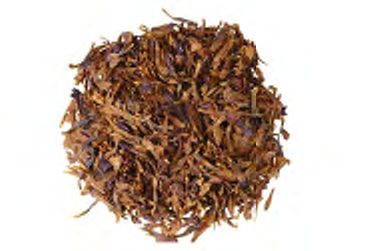
Figure 1: Authenticated crude herb specimen — Borago officinalis flower.
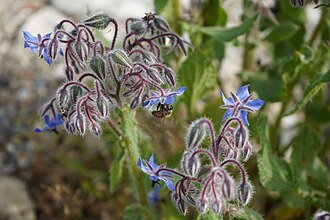
Botanical Reference 1: Borage — Botanical specimen
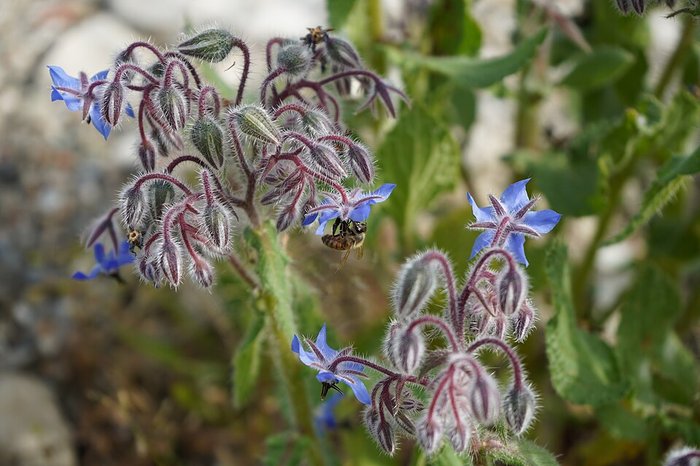
Botanical Reference 2: Borage — Botanical specimen
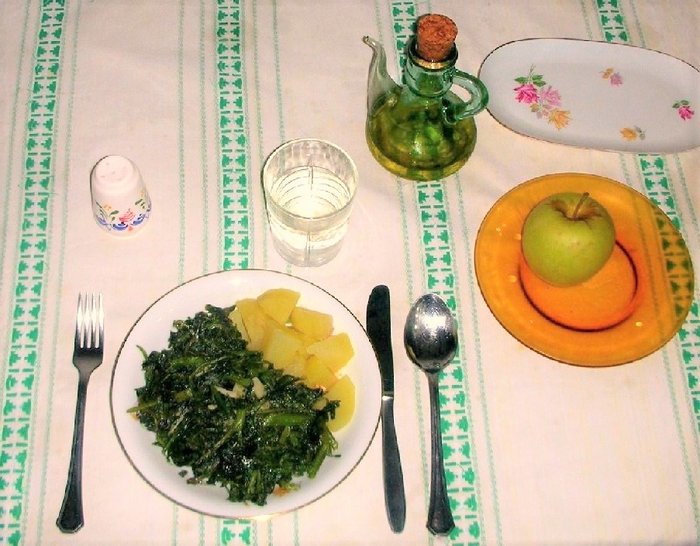
Botanical Reference 3: Borago officinalis — Wikimedia Commons reference
4. Comparative Genus & Family Pharmacognosy
Within Indian medicinal flora, Borago officinalis stands as a distinct representative of the genus Borago. Its therapeutic profile underscores the role of selectively utilized medicinal genera alongside larger polytypic genera.
At the family level, Boraginaceae encompasses 16 documented medicinal species (0.88% of the 1,814-species flora). Other representative medicinal members of Boraginaceae include: Alkanna tinctoria (Alkanet), Anchusa italica (Gojihvikaa), Arnebia benthamii (Kashmiri Gaozabaan), Caccinia crassifolia, Cordia myxa (Shleshmaataka). In comparative pharmacognosy, evaluating species within the same botanical family aids quality control, authentication of crude drugs, and identification of chemotaxonomic markers.
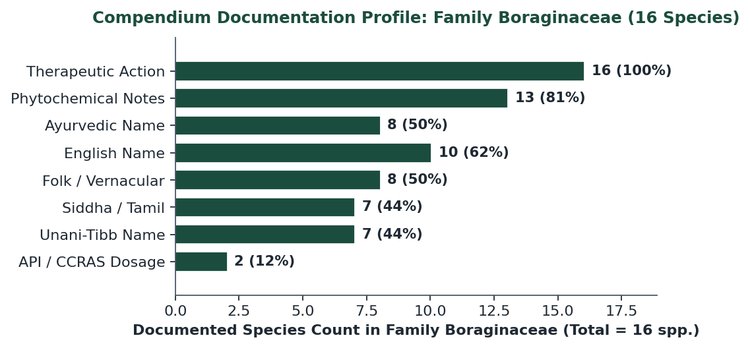
Figure 2: Quantitative documentation profile across all 16 medicinal species of family Boraginaceae.
5. Pharmacopoeial Standards, Posology & Reference Framework
In clinical and traditional dispensing, preparation and administration of Borago officinalis follow the plant-part modalities specified under its therapeutic action (Fresh herb (compounded with water)—refreshing, restorative and nervine tonic. Leaves and flowers—diuretic, febrifuge, expectorant, demulcent, emollient; promote the activity of kidneys; alleviate pulmonary affections), guided by the standard posological principles of The Ayurvedic Pharmacopoeia of India (Vols. I–IV) and CCRAS formularies. Classical and modern pharmacognostic synchronization for Borago officinalis integrates standards from The Ayurvedic Pharmacopoeia of India, The National Formulary of Unani Medicine, Formulary of Siddha Medicine, The Wealth of India (CSIR), Compendium of Indian Medicinal Plants (CDRI), Dictionary of Indian Medicinal Plants (CIMAP), German Commission E, ESCOP, WHO monographs, British Herbal Pharmacopoeia, and Natural Medicines Comprehensive Database.