Brucea sativa
1. Taxonomic, Nomenclature & Therapeutic Summary Table
| Botanical Attribute | Pharmacognostic & Therapeutic Specification |
|---|---|
| Action | Taraamiraa (Jirjeer)— used in Unani medicine as a spermatic tonic (powder of seeds is administered with a half-fried egg), also as a blood purifier, diuretic, emmenagogue and deobstruent. Leaf juice—used as a lotion for blotches, spots and blemishes. |
| Taxonomic Cohort | Genus Brucea (1 documented species); Family Unclassified (12 documented species). |
2. Classical Nomenclature, Taxonomy & Biogeographical Context
Brucea sativa is an established medicinal plant species in Indian materia medica. It is cataloged as a specialized classical drug entry within Indian medicinal flora. Within botanical taxonomy, this taxon is cataloged directly under its primary accepted binomial without secondary botanical synonyms. Its biogeographical provenance spans the natural distribution range of its allied congeneric taxa.
Within traditional medical nomenclature, Brucea sativa is identified primarily by its scientific Latin binomial rather than separate classical Sanskrit, Persian-Arabic, or Tamil vernacular synonyms, serving as a direct botanical and phytochemical reference taxon.
3. Therapeutic Actions, Phytochemistry & Pharmacological Profile
In therapeutic and clinical pharmacognosy, the primary recorded actions and clinical indications of Brucea sativa are: Taraamiraa (Jirjeer)— used in Unani medicine as a spermatic tonic (powder of seeds is administered with a half-fried egg), also as a blood purifier, diuretic, emmenagogue and deobstruent. Leaf juice—used as a lotion for blotches, spots and blemishes. These traditional and clinical attributes reflect the plant part-specific pharmacological profile documented across classical Indian treatises and modern herbal pharmacopoeias.
Experimental phytochemistry, active chemical constituents, and pharmacological screening studies reported for Brucea sativa establish the following evidence base: National Formulary of Unani Medicine, Part I, equated Jirjeer with Brucea sativa Mill. or Nasturtium officinale R. Br. Nasturtium officinale, found in Europe, is known as watercress. Indian cress is cultivated in gardens as a creeper. Brucea is a totally different species (Simaroubaceae). Taraamirra of Unani medicine should be equated with Eruca sativa and not with Brucea sativa. Nasturtium officinale (Brassicaceae): Antiscorbutic and stimulant. A rich source of vitamins A and E, also of ascorbic acid. Seeds contain gluconcasturtin. Used for metabolic disorders, anaemia, strangury, kidney and bladder disorders and catarrh of the respiratory tract. Eruca sativa Mill.: Cultivated in North India; known as Taraamiraa, Siddhaartha, Bhutaghna. Seeds are used like mustard. Seeds—antibacterial. Crude juice of the plant inhibited E. coli, S. typhi and B. subtlis. Seeds contain (4-Me-thio)-Bu-glucosinolate (glucoerucin) as K and tetra-Me-N salts. A composition is used in induration of liver.
4. Comparative Genus & Family Pharmacognosy
Within Indian medicinal flora, Brucea sativa stands as a distinct representative of the genus Brucea. Its therapeutic profile underscores the role of selectively utilized medicinal genera alongside larger polytypic genera.
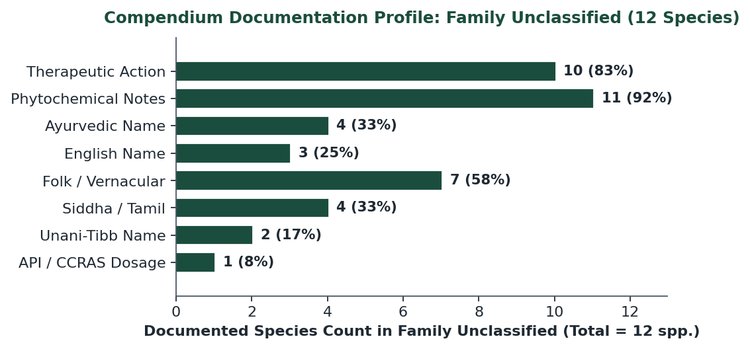
Figure 1: Quantitative documentation profile across all 12 medicinal species of family Unclassified.
5. Pharmacopoeial Standards, Posology & Reference Framework
In clinical and traditional dispensing, preparation and administration of Brucea sativa follow the plant-part modalities specified under its therapeutic action (Taraamiraa (Jirjeer)— used in Unani medicine as a spermatic tonic (powder of seeds is administered with a half-fried egg), also as a blood purifier, diuretic, emmenagogue and deobstruent. Leaf juice—used as a lotion for blotches, spots and blemishes), guided by the standard posological principles of The Ayurvedic Pharmacopoeia of India (Vols. I–IV) and CCRAS formularies. Classical and modern pharmacognostic synchronization for Brucea sativa integrates standards from The Ayurvedic Pharmacopoeia of India, The National Formulary of Unani Medicine, Formulary of Siddha Medicine, The Wealth of India (CSIR), Compendium of Indian Medicinal Plants (CDRI), Dictionary of Indian Medicinal Plants (CIMAP), German Commission E, ESCOP, WHO monographs, British Herbal Pharmacopoeia, and Natural Medicines Comprehensive Database.