Clausena pentaphylla (Roxb.) DC.
1. Taxonomic, Nomenclature & Therapeutic Summary Table
| Botanical Attribute | Pharmacognostic & Therapeutic Specification |
|---|---|
| Family | Rutaceae. |
| Habitat | The sub-Himalayan tract from Garhwal to Sikkim; also in Chakrata range. |
| Folk | Ratanjot (var.), Rowana. Surasi is a doubtful synonym. |
| Action | Bark—anti-inflammatory, spasmolytic; used in veterinary medicine for wounds and sprains. |
| 2 | , 3 ▶ -epoxy-anisolactone have been |
| Taxonomic Cohort | Genus Clausena (1 documented species); Family Rutaceae (31 documented species). |
2. Classical Nomenclature, Taxonomy & Biogeographical Context
Clausena pentaphylla (taxonomically cited with authority (Roxb.) DC.) is an established medicinal plant species in Indian materia medica. It is classified under the botanical family Rutaceae (primary family classification: Rutaceae), placing it within a well-defined chemotaxonomic group of medicinal flora. Within botanical taxonomy, this taxon is cataloged directly under its primary accepted binomial without secondary botanical synonyms. Biogeographically, its documented habitat and ecological distribution span: The sub-Himalayan tract from Garhwal to Sikkim; also in Chakrata range.
Across classical and vernacular Indian systems of medicine, Clausena pentaphylla is recognized under distinct polyglot nomenclature: in regional Indian folk and vernacular ethnobotany as Ratanjot (var.), Rowana. Surasi is a doubtful synonym. Romanized Sanskrit and Ayurvedic spellings follow standard National Academy of Ayurveda (Rashtriya Ayurveda Vidyapeeth) transliteration conventions, using double vowels to preserve authentic classical pronunciation across regional medical traditions.
3. Therapeutic Actions, Phytochemistry & Pharmacological Profile
In therapeutic and clinical pharmacognosy, the primary recorded actions and clinical indications of Clausena pentaphylla are: Bark—anti-inflammatory, spasmolytic; used in veterinary medicine for wounds and sprains. These traditional and clinical attributes reflect the plant part-specific pharmacological profile documented across classical Indian treatises and modern herbal pharmacopoeias.
Experimental phytochemistry, active chemical constituents, and pharmacological screening studies reported for Clausena pentaphylla establish the following evidence base: Aerial parts contain coumarins— clausmarins A and B. Coumarins exhibit spasmolytic activity. The root also contains coumarins. Root and stem bark of Clausena excavata Burm. f. Eastern sub-Himalayan tract, Orissa and Bihar) also contain coumarins— clausenin and clausenidin. The root bark exhibits antibacterial activity against both Gram-positive and Gramnegative bacteria. A related species, C. anisata (Willd.) Oliver, is reported from Uttar Pradesh. Ethanolic extract of the aerial parts exhibited spasmolytic activity. The furanocoumarins, anisolactone, xanthotoxol, indicolactone, imperatorin and isolated from the extract. In West African traditional medicine, the decoction of the root is given to control convulsions in children. The anticonvulsant agent has been found to be heliettin, extracted from the stem bark and roots.
4. Comparative Genus & Family Pharmacognosy
Within Indian medicinal flora, Clausena pentaphylla stands as a distinct representative of the genus Clausena. Its therapeutic profile underscores the role of selectively utilized medicinal genera alongside larger polytypic genera.
At the family level, Rutaceae encompasses 31 documented medicinal species (1.71% of the 1,814-species flora). Other representative medicinal members of Rutaceae include: Aegle marmelos (Bilva), Atalantia monophylla (Wild Lime), Chloroxylon swietenia (Provisionally equated with Bhillotaka), Citrus aurantifolia (Nimbuka), Dictamnus albus (Gas Plant). In comparative pharmacognosy, evaluating species within the same botanical family aids quality control, authentication of crude drugs, and identification of chemotaxonomic markers.
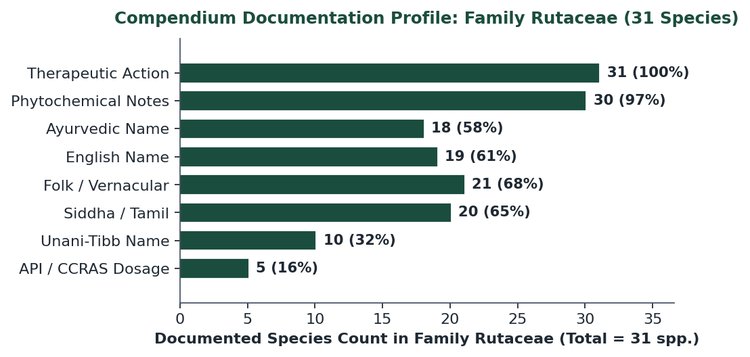
Figure 1: Quantitative documentation profile across all 31 medicinal species of family Rutaceae.
5. Pharmacopoeial Standards, Posology & Reference Framework
In clinical and traditional dispensing, preparation and administration of Clausena pentaphylla follow the plant-part modalities specified under its therapeutic action (Bark—anti-inflammatory, spasmolytic; used in veterinary medicine for wounds and sprains), guided by the standard posological principles of The Ayurvedic Pharmacopoeia of India (Vols. I–IV) and CCRAS formularies. Classical and modern pharmacognostic synchronization for Clausena pentaphylla integrates standards from The Ayurvedic Pharmacopoeia of India, The National Formulary of Unani Medicine, Formulary of Siddha Medicine, The Wealth of India (CSIR), Compendium of Indian Medicinal Plants (CDRI), Dictionary of Indian Medicinal Plants (CIMAP), German Commission E, ESCOP, WHO monographs, British Herbal Pharmacopoeia, and Natural Medicines Comprehensive Database.